01The problem
Faith is one of consumer software's fastest-growing categories, and the winners compete on three axes — free breadth, denominational prayer, and habit-gamified wellness. None of them serves the reader in the deep-life / exchanged-life tradition: someone tired of trying harder, looking for depth rather than streaks. And none of them will ship an AI companion that answers questions — for a concrete reason: open language models misquote Scripture an estimated 15–60% of the time. In a domain where fidelity to the text is the entire point, a hallucinating companion isn't a bug. It's a betrayal.
That constraint is the opportunity. The reader hungry enough to go deeper is the most valuable user in the category — and the only one no incumbent is built to serve.
02Design decisions
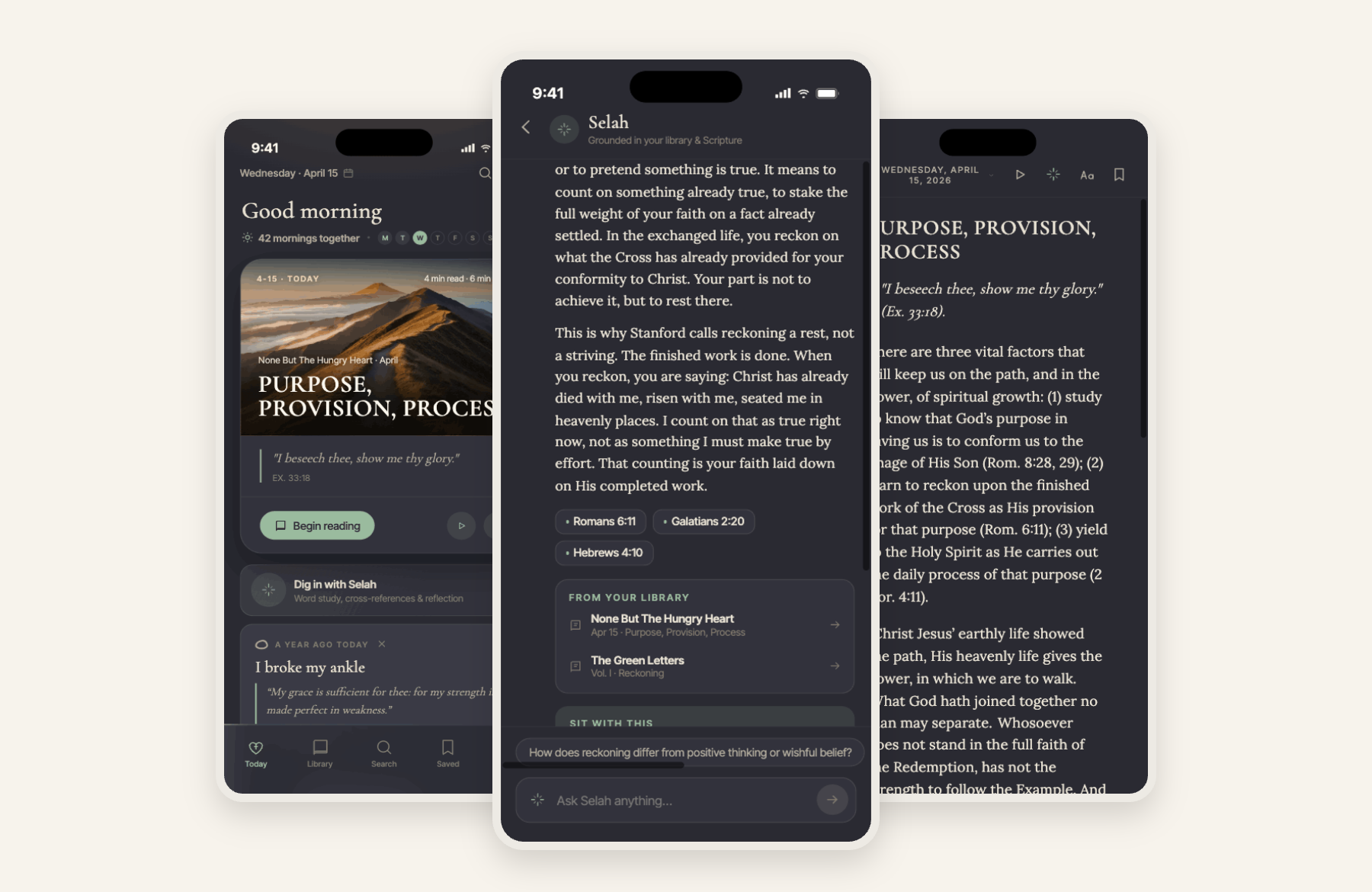
Selah is corpus-fenced — grounding IS the product
In prototypeOpen chatbot vs. a companion fenced to a licensed, curated corpus
The AI companion answers only from the tradition's own writings — it never routes the reader out to a general model's opinion of theology. What every competitor treats as a limitation (can't ship Q&A, models hallucinate) becomes the wedge: the only companion in the category you can trust with the text, because it can't speak beyond it.
Impact: context engineering deployed as market position, not plumbing
"42 mornings together" — the anti-streak
Streaks: killedStreaks, flames, and rings vs. a gentle record
The habit-app reader opens to a ring to close and a flame not to lose; miss a day, see red, feel behind — formation framed as performance, the exact striving this tradition spent a century answering. Abide Above opens like a book and remembers warmly: "42 mornings together." Every feature passes one eval before any other: does it deepen abiding, or does it import striving? Features that scored "impressive" and failed that test died in the backlog.
Impact: a values-derived eval framework governing the roadmap — principled metric pushback, productized
Reverence as interface
In prototypeApp chrome vs. a reading instrument
Warm-paper aesthetic — Cormorant Garamond display, four reading themes (Day / Sepia / Dusk / Night), typography tuned for slow reading. The product looks like what it asks of you: quiet attention. Includes an embedded in-app book checkout designed so the reader never bounces out mid-intention.
Impact: the brand thesis and the UI are the same argument
03What the pipeline produced
Same engine as the Ellev8 agent system and theventure in stealth. Second full run, different market:
- Opportunity brief — six-competitor landscape, white-space analysis, honest risk disclosure (the corpus-rights agreement named as the gating item before anything public)
- Working app prototype — React, componentized, themable, with Selah and the reading experience interactive
- Full marketing site — About, The Book, The Library, Membership
- Investor tour — 18 slides with a guided prototype walkthrough and speaker notes
- Product roadmap + user journeys — from prototype to React Native ship plan
- A warm beachhead — ~1,300 existing readers of the tradition plus a church-and-conference network; a community, not a cold start
04Key learning
"Grounding isn't a constraint on the AI — it's the product. The moment the companion can only speak from the tradition, trust stops being a leap."
The industry lesson generalizes far beyond faith software: in any domain where source fidelity is the point — legal, medical, brand, scripture — the corpus fence is not the compromise position. It's the premium one. I'd make the same call at any company shipping AI into a trust-critical surface.