Adding a continuity rewards program across a billion-clip ecosystem · DG Rewards
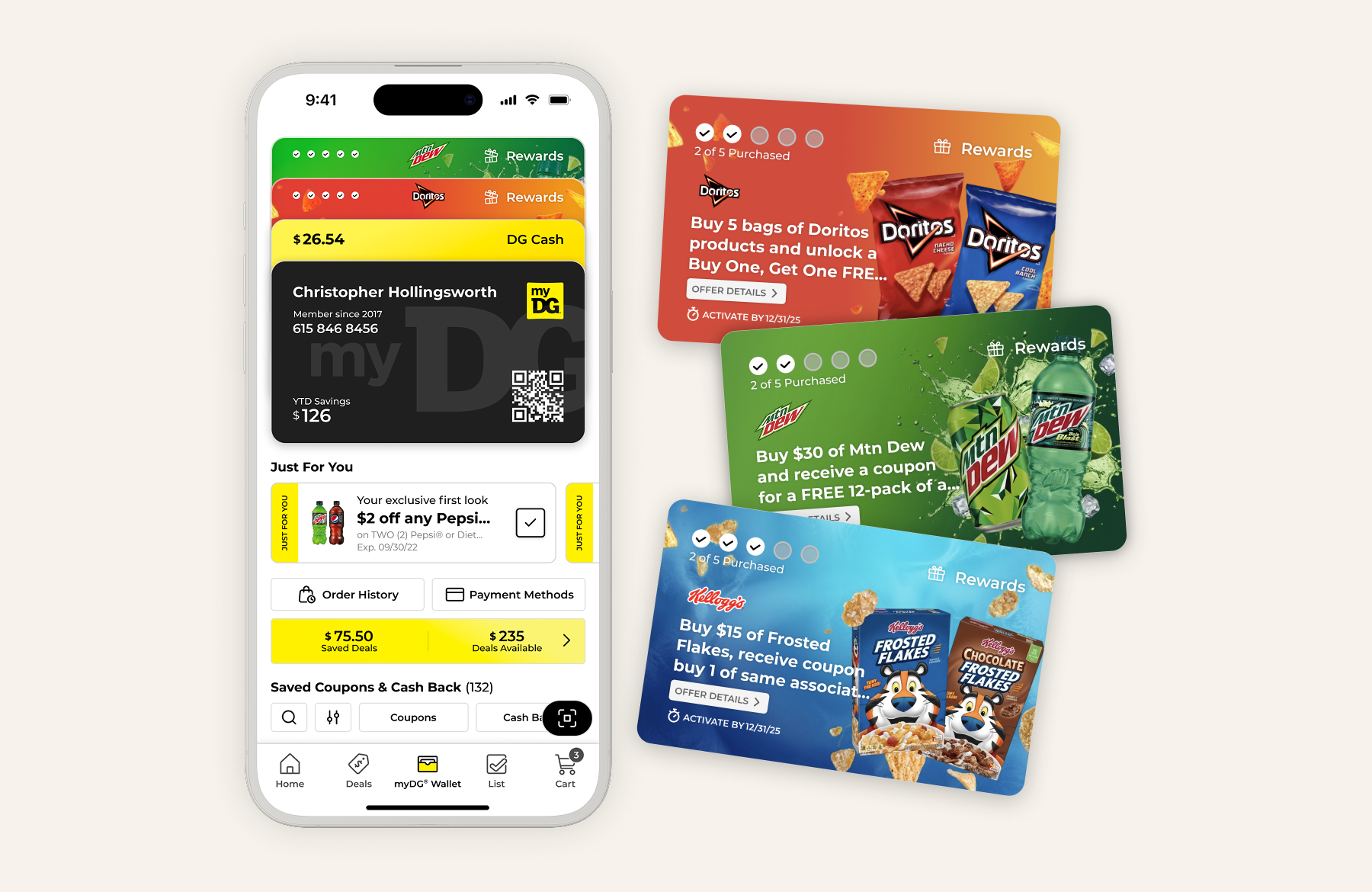
Dollar General needed Rewards — a continuity-based deal type — across every touchpoint from discovery to checkout, on three platforms, without fragmenting an ecosystem already serving a billion annual deal clips. So I designed the card system first, then the funnel.
DG Rewards — continuity cards across the funnel
Role
UX lead & design direction
Team
5-person cross-functional
Timeline
Q3 2025 – Q1 2026
Platforms
App · Mobile Web · Desktop Web
01The problem — a new deal type in a complex ecosystem
Dollar General's deals ecosystem already served 12M monthly active users — digital coupons, Cash Back (via the Ibotta Performance Network), and DG Cash co-mingled in a single gallery driving over a billion annual clips. Thestackable wallet architecture I'd designed earlier made the system ready to absorb new deal types. The system was working.
Now the business wanted to add Rewards — a continuity-based deal type where customers earn by purchasing qualifying products over time (buy 3, get $2 back). Unlike one-time-clip coupons, Rewards needed to:
Track progress across multiple shopping trips
Display real-time status — inactive → in-progress → earned
Coexist alongside existing deal types without adding cognitive load
The risk: add a new deal type poorly and you fragment an experience millions depend on — across gallery, product listing, product detail, wallet, and checkout, on three platforms simultaneously.
02The approach — design the card system first, then the funnel
Rather than designing screens for each touchpoint, I started with the card itself. The Rewards card had to be a self-contained component that could live in any context — a gallery tile, a product-page badge, a wallet stack, or a checkout summary — and communicate its state at a glance.
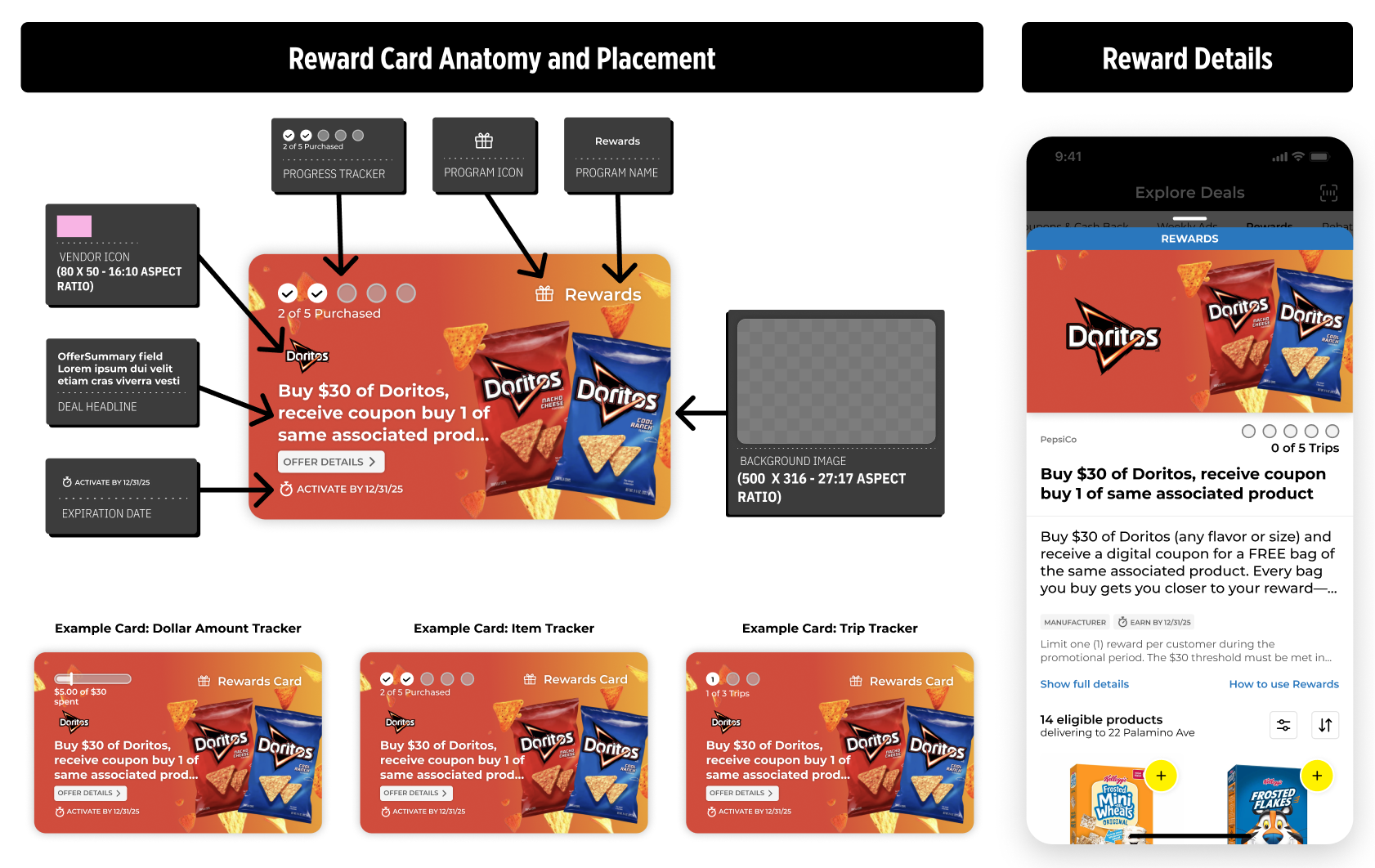
I defined three card constructs, each with a distinct progress visualization that made the earn mechanic immediately legible:
Dollar-amount tracker — spend $30, get $5 (dollar fill)
The card anatomy — vendor branding, savings headline, progress indicator, program icon, expiration — was governed by a single spec sheet that merchandising, art, and engineering could all build from.
The card spec — anatomy, tracker types, and placement rules, one source of truth for every surface
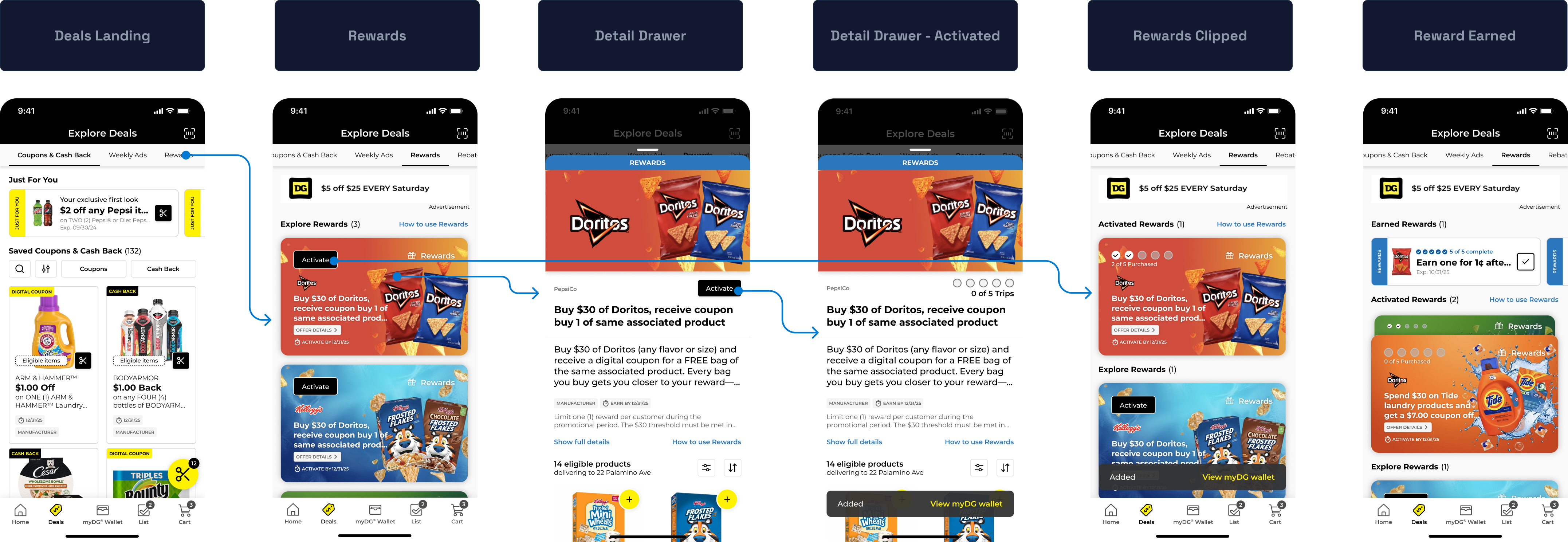
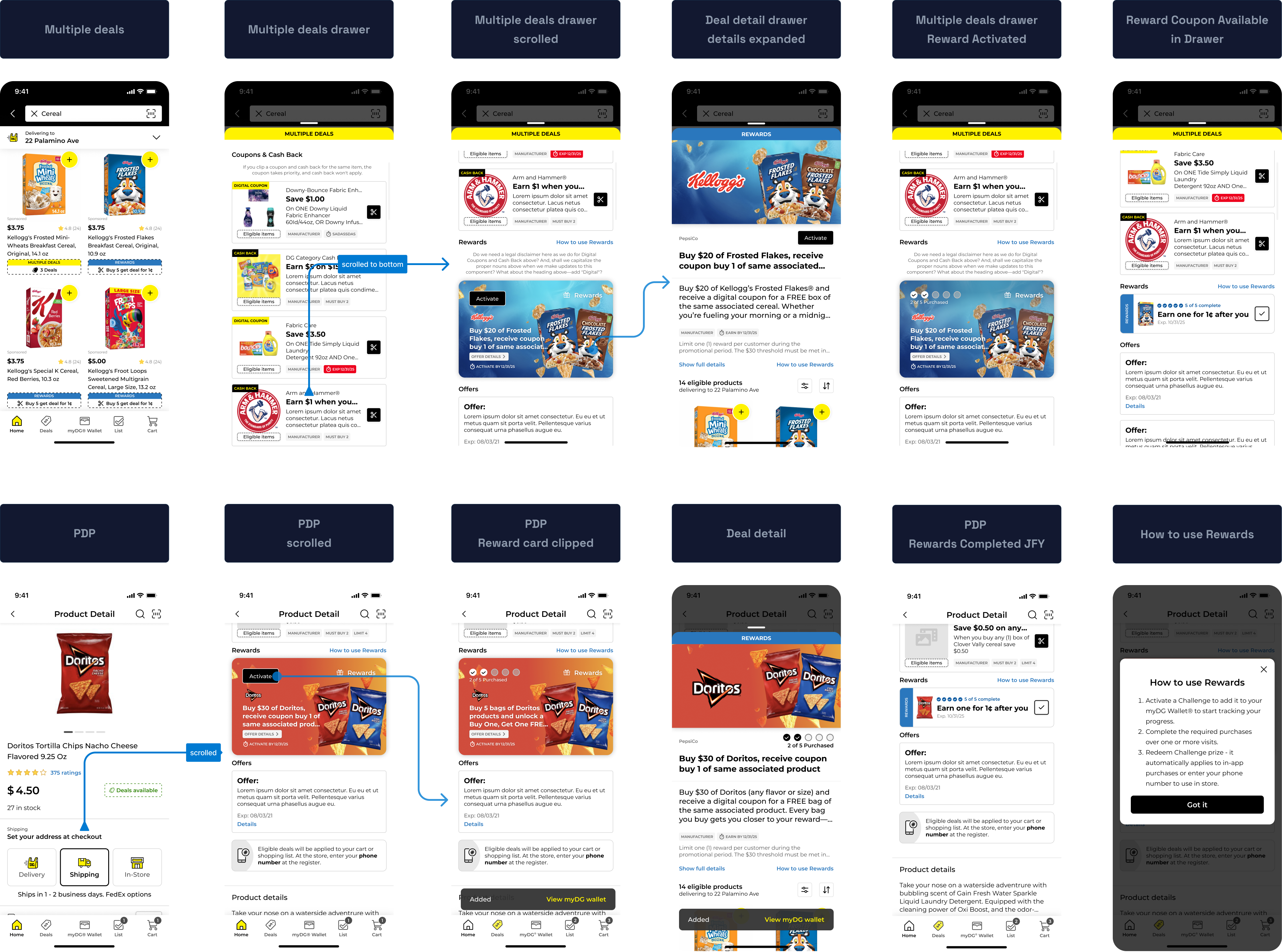
With the card system defined, I mapped the full funnel. Each touchpoint answers a different question — "What's available?" → "Does this qualify?" → "How close am I?" → "What have I earned?" → "What am I redeeming?" — and the card adapts to each context while holding visual consistency.
03Five choices that shaped the system
Component-first architecture over screen-first design. One card component with context-aware variants — full detail in the gallery, compact badge on listing tiles, stacked in the wallet, summary at checkout. One source of truth for engineering; consistency across every surface.
Expandable card interaction over static detail pages. Navigating to a detail page broke browsing flow — customers lost scroll position and context. The card expands inline to show details and progress, keeping browsing momentum intact.
Three tracker types with distinct progress visualization. "Spend $30" is a different mechanic from "buy 5 items" or "shop 3 trips." Rather than a generic bar, each earn type got its own visualization — because how you earn it is the product.
Co-mingled discovery over a separate Rewards tab. The business considered a standalone tab, but Cash Back research showed customers don't think in deal categories — they think "useful" vs. "not useful." Rewards landed in the existing gallery alongside coupons and cash back.
Cross-platform parity with platform-appropriate patterns. Native bottom sheet on App, modal on Mobile Web, inline expansion on Desktop — shared card components, each platform's own conventions respected.
04The system across the funnel
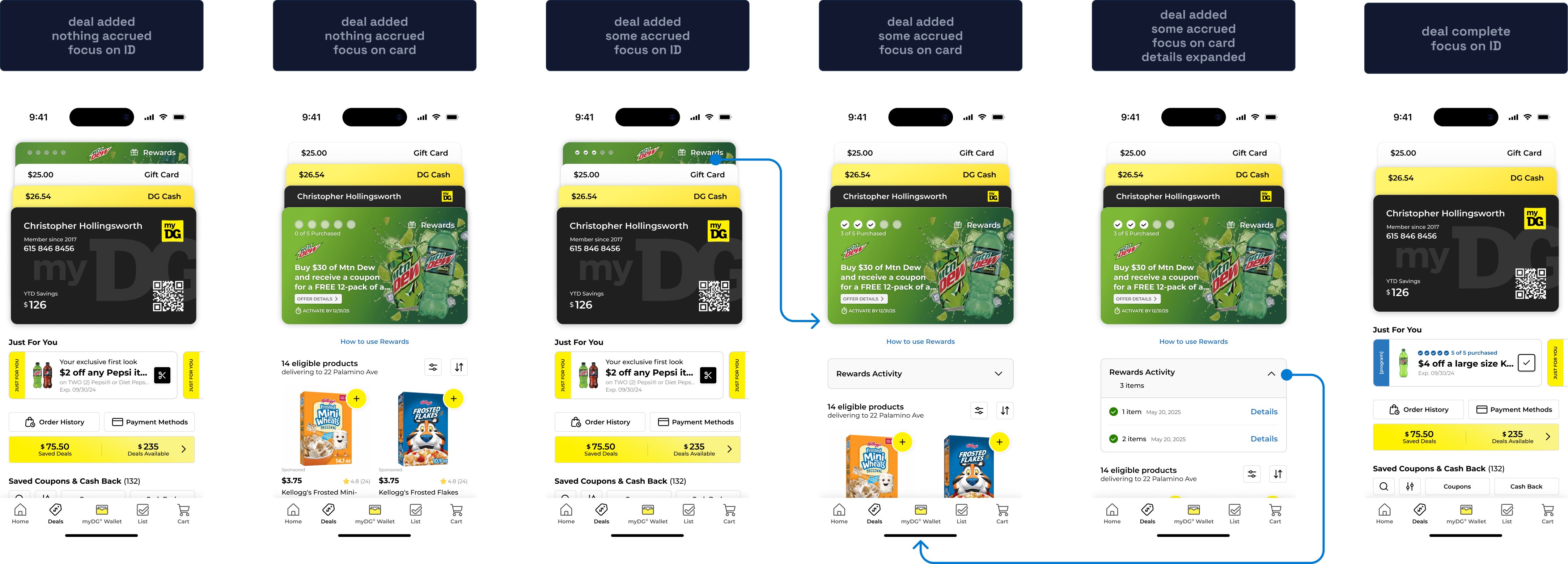
The same card, adapting context to context — discovery in the gallery, qualification in the drawer and product detail, earned value in the wallet, redemption at checkout.
Deals Gallery — App · Rewards co-mingled with coupons and cash back, from landing to reward earnedDeals Drawer & PDP — App · the card expands inline; qualifying products and progress without a page transitionWallet — App · active progress, earned coupons, and redeemable savings in the same stack customers already trusted
05Results — production-ready at scale
Rewards was delivered production-ready for Phase 2 launch — a complete deal type integrated across the entire shopping funnel, built on an ecosystem already proving its effectiveness at scale.
Rewards extended an ecosystem already operating at scale:
191%
YoY deal-clip growth — Cash Back ecosystem trajectory
$9M
Customer savings — DG Cash earned through deals
12M+
Monthly active users — across App + Web
06Key learning — integration is harder than invention
Rewards could have been a standalone feature — its own section, its own flow, its own visual language. Faster to ship, easier to scope. But it would have fractured a shopping experience millions of customers already relied on.
The decision that mattered most wasn't any individual screen — it was the commitment to make Rewards a native citizen of the existing ecosystem: discoverable through the same patterns customers knew, traceable through the same wallet they trusted, redeemable through the same checkout they'd already learned.
"Shipping a feature is easy. Earning the right to live inside someone else's workflow — that's the real design problem."